


Commercial cotton crops have been trialled in both the Gilbert and Flinders River catchments (e.g., Stranbroke and Silver Hills Stations). However, without sufficient scale to support a local gin, cotton production would be expected to be uneconomic.
The concept of developing a cotton gin in Far North / North-West Queensland has been previously contemplated by multiple proponents to increase the supply-chain efficiency of cotton cropping in this region. This has included the potential for a modular style gin in the vicinity of Richmond and as a component of Stanbroke’s Three Rivers Irrigation Project, which is now a lapsed co-ordinated project. However, reflecting the chicken and egg scenario with production, a cotton gin is unviable without the confidence that production could be scaled up to achieve minimum viable operating levels.
To be viable, investment in a gin must be sustainably supported by the reliable production of 10,000 to 12,000 hectares of cotton cropping generating approximately 100,000 bales per annum with average yields in the order of 9 to 10 bales per hectare.
In order to provide confidence in cotton production potential, Namoi Cotton commissioned a study in relation to potential cotton production areas in Far North and North-West Queensland. Among other things this study assessed the potential extent of land available and suitable for cotton production within an economic transport distance around six “nodes” distributed across the Gulf Coast and Cape York region. Within areas suitable for cotton production, expected yield was modelled, and potential long-term climate change impacts on yield forecast.
The study also carried out a multi-criteria analysis to evaluate and rank regions in terms of their viability to support a cotton growing and processing industry. This considered 15 factors across the categories of land viability, water availability and production risks and opportunities.
The study recognised that successful schemes have typically been built on local farming capacity, noting that cropping systems will likely adapt over time to emergent markets and developing supply chains and logistics as local capacity builds in terms of skills and knowledge.
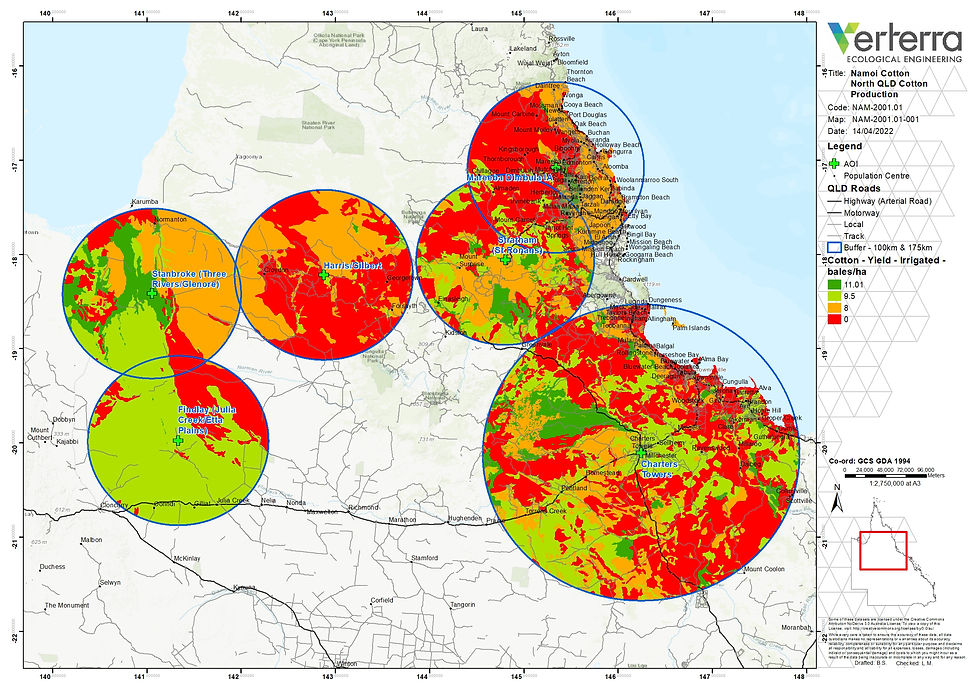
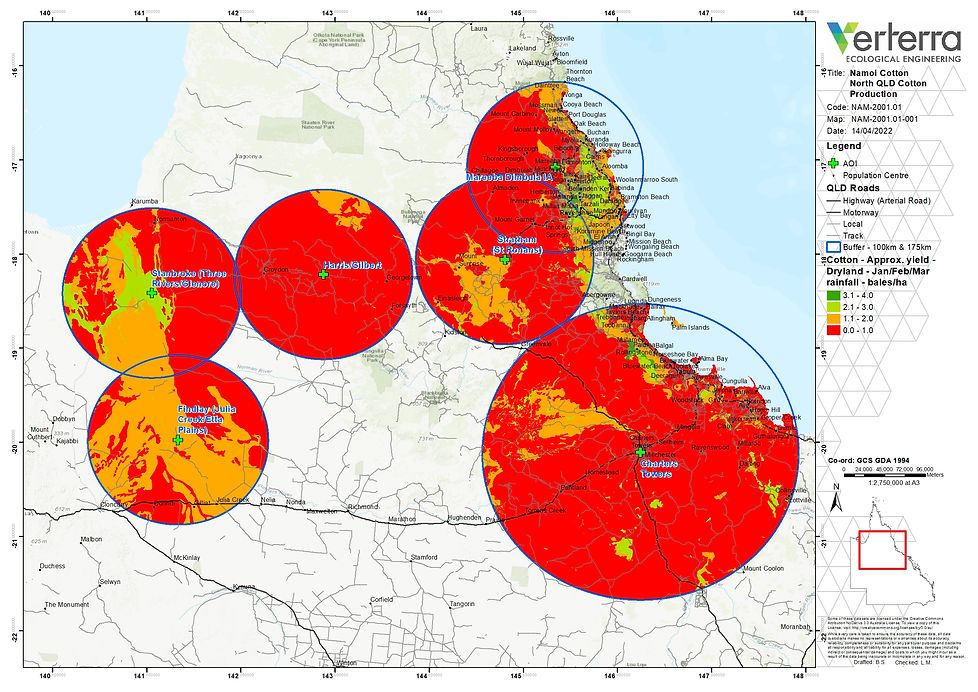
Land capability maps illustrating the extent of land suitable for potential cotton production, and indicative yield for irrigated and dryland cotton, are presented in the following diagrams.
The capacity for development of new irrigation areas throughout Queensland is, among other things, regulated by the requirement for vegetation clearing. Under the Queensland Vegetation Management Act, the clearing of regulated vegetation for agricultural development is considered a Relevant Purpose. Assessment and approval of vegetation clearing by the Coordinator General can be a long process requiring a number of years.
Under the State Development Assessment Provisions (SDAP): State Code 16, applicants for coordinated projects involving agriculture must demonstrate that the land is suitable for the proposed crop(s).
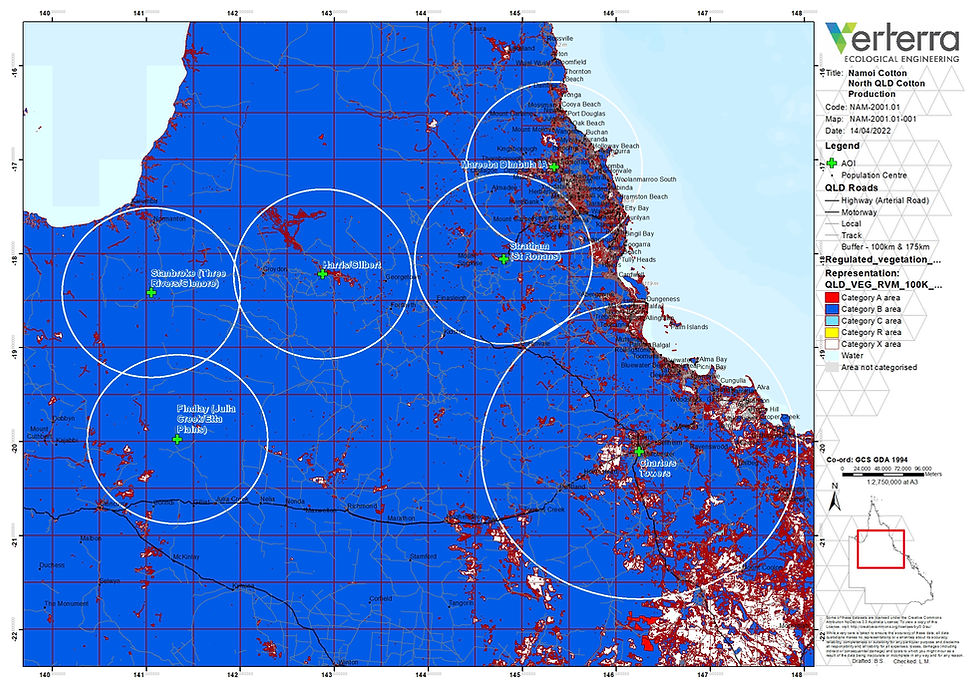
Relevant native vegetation includes Category A, B, C and R vegetation. The extent of regulated vegetation on Cape York is illustrated in the figure below. This figure indicates that the majority of the Cape is regulated and subject to an extended approval pathway to clearing for irrigated cotton development.
The study found adequate areas of land capable of supporting a gin based on irrigated cotton around all nodes investigated, but dryland cotton was only viable around the Mareeba, Burdekin and St Ronans nodes.
A secondary benefit of cotton production for ginning is cotton seed by-product, which could be made available to the local grazing industry as a feed supplement.
Notwithstanding adequate land suitable for cotton production, the extent of regulated vegetation is a hurdle that will require Coordinator General approval and may involve an extended approval pathway to clearing approvals for irrigated development. Dryland farming may be able to avoid clearing on designated grasslands where trees are sparse, but any tree clearing on non-grasslands will require the same approval as for irrigated developments.