


The Vegetation Management Act (VMA) regulates the clearing of vegetation in a way that:
Subordinate legislation:
The Act considers vegetation to be a native tree or plant other than:
Additionally, the Act considers clearing to mean:
Relevance to cropping development:
Of the various legislative requirements, compliance with the Vegetation Management Act is generally the most significant consideration. Definitions in the Act as to what constitutes a “tree”, “vegetation”, “clearing” and “Infrastructure” are important in interpreting the Act. Based on the State vegetation mapping and proposed development parameters (dryland, irrigated, etc.) land may be classified with respect to the Vegetation Management Act into the following four categories:
This represents land that is mapped as:
Note, trees are not considered as “Vegetation” under the Vegetation Management Act when they occur within a Grassland Regional Ecosystem, so may be cleared.
This represents land that is mapped as:
By nature, this is only applicable to fixed infrastructure such as fence lines, building sites, irrigation delivery pipelines, etc.).
This represents land that is mapped as:
By nature, this is applicable to irrigated agricultural developments where tree clearing is required to construct moving infrastructure such as centre pivots or drylands agriculture where tree clearing is required for cultivated rows).
This represents land that is mapped as:
The Flowchart sets out the above decision processing determining how land is classified under the Vegetation Management Act.
The StoryMap will guide you through the vegetation management mapping process and allow you to navigate to your property and identify which parts of your property as classified into each of the above four categories.
Please note, clarification of the Vegetation Management Act requirements and restrictions is a starting point in determining the regulatory requirements for cropping development. At the scale of the available mapping, this will often point to further investigations required rather than provide a definite answer. In addition, other State, Federal and Local legislation and planning requirements listed below will also need to be taken into account.
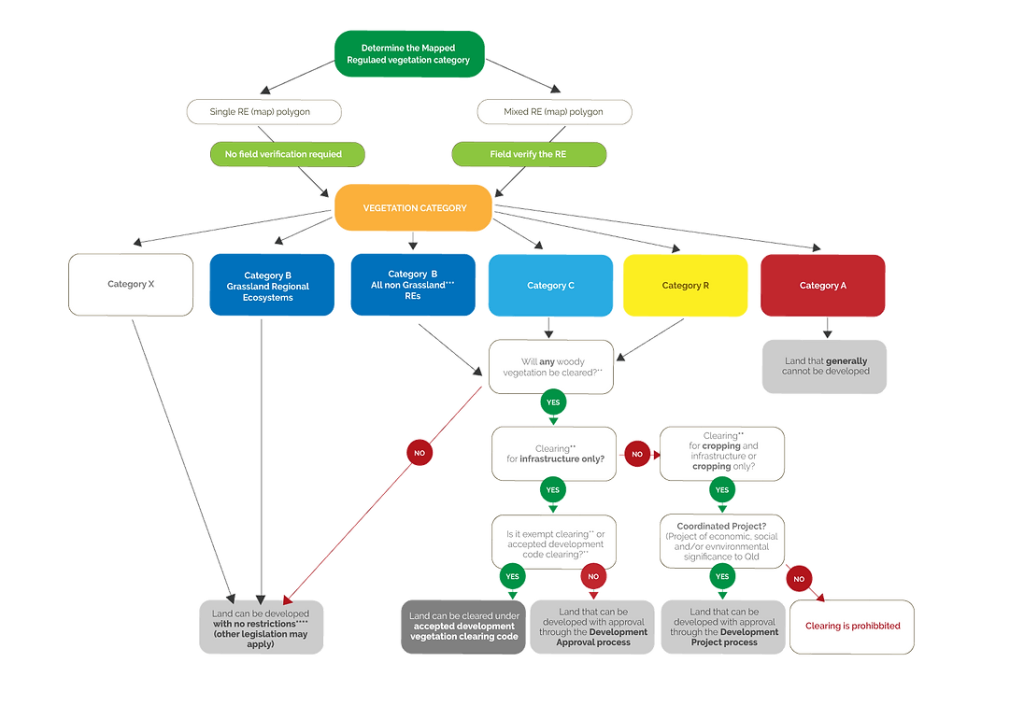
*Vegetation Category can e obtained from:
If you consider your land to e innncorrectly mapped, a property map of assessable vegetation (PMAV) can be applied for through the Department of Resources
**Note that clearing also includes he death of vegetation due to flooding or other changes to hydrology but does not include lopping where the loping does not kill the tree/shrub.
***Includes Woody grassland REs, Woodlands and Forests
****Check with Local Council to determine if the proposed development constitutes a Materil Change. Development approval maybe required.
This Act establishes a system of land use planning, development assessment, and facilitates the achievement of ecological sustainability.
Integrating:
Subordinate legislation:
Relevance to cropping development:
This Act provides a framework for:
Subordinate legislation includes:
Relevance to cropping development includes:
The object of this Act is the conservation of nature, achieved by:
Subordinate legislation includes:
Relevance to cropping development includes:
This is “an Act to provide for State planning and development through a coordinated system of public works organisation, for environmental coordination, and for related purposes.” This Act has the authority under which the Coordinator General declares a Coordinated Project.
Subordinate legislation:
Relevance to cropping development:
* Not applicable for projects requiring an IAR.
^ Public release of an IAR is not required in all circumstances.
The main purpose of this Act is to provide for the use, conservation and enhancement of the community’s fisheries resources and fish habitats in a way that seeks to:
Subordinate legislation includes:
Relevance to cropping development includes:
The Queensland Land Act 1994 regulates the management and use of land in Queensland based on the principles of:
Subordinate legislation includes:
Relevance to cropping development includes:
The main purpose of this Act is to provide effective recognition, protection and conservation of Aboriginal cultural heritage.
Subordinate legislation includes:
Relevance to cropping development includes: